
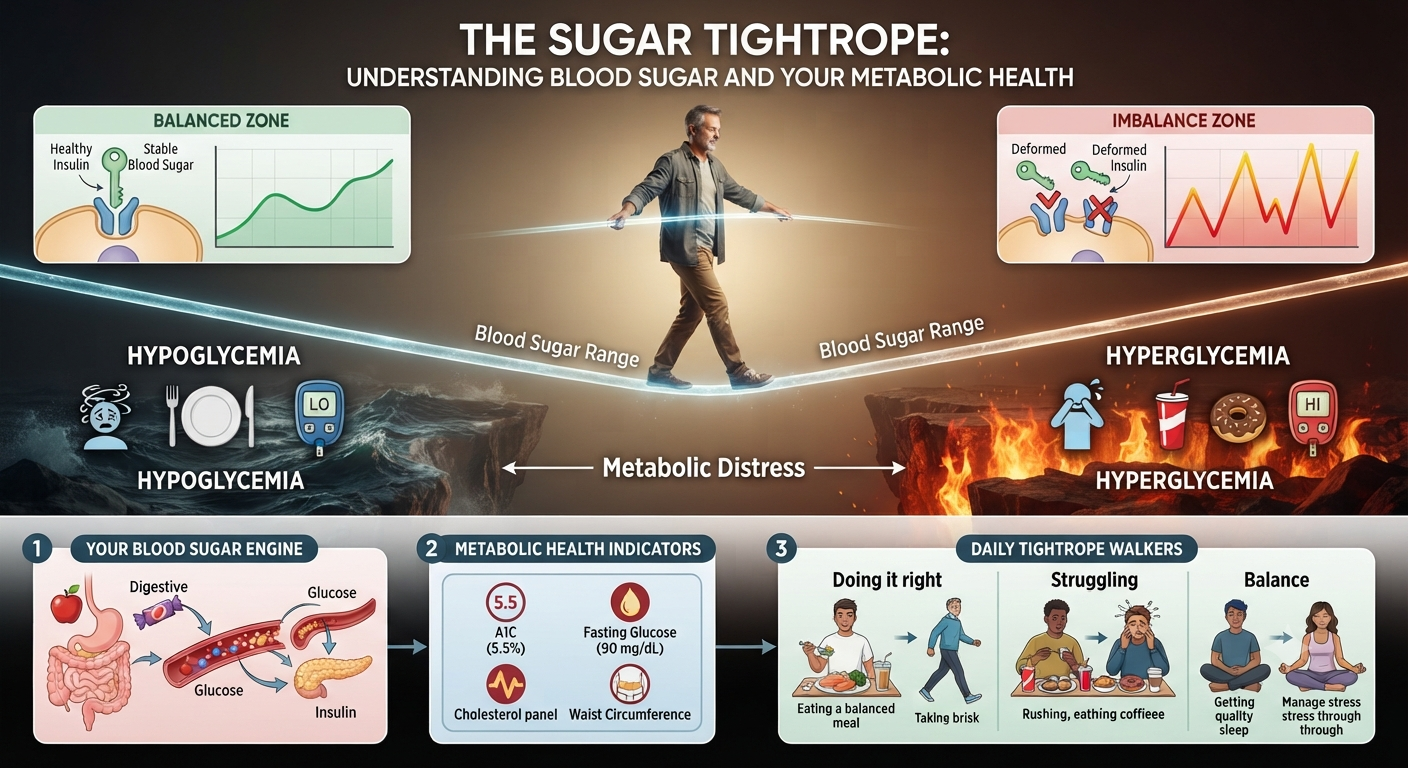
There is a number inside your body that tells a story about your future. It rises when you eat, falls when you fast, and shifts in response to sleep, stress, and movement. Most people never see it, never feel it, and never think about it. Yet it is one of the most powerful predictors of how long you will live, and how well.
That number is your blood sugar.
Blood sugar is not just a concern for people with diabetes. It is a window into your metabolic health—the way your body processes energy, responds to hormones, and stores fat. When blood sugar stays in a healthy range, your body works efficiently. When it drifts upward, even slightly, the consequences accumulate silently over years, sometimes decades, before a diagnosis ever appears on a chart.
This guide is your introduction to blood sugar and metabolic health. What they are, how they are measured, and what you can do to keep them in balance.
What Blood Sugar Actually Is
Blood sugar, or blood glucose, is the amount of sugar circulating in your bloodstream at any given moment. It is not an enemy. It is fuel—the primary energy source for every cell in your body, from your brain to your muscles to your organs .
When you eat carbohydrates, your digestive system breaks them down into glucose, which enters the bloodstream. In response, your pancreas releases insulin, a hormone that acts like a key, unlocking your cells so glucose can enter and be used for energy . Some glucose is used immediately. Some is stored in the liver and muscles as glycogen. Excess is converted to fat.
This system is elegant when it works. Blood sugar rises after a meal, insulin rises to meet it, glucose moves into cells, and blood sugar returns to baseline within two to three hours . In a healthy person, this dance happens smoothly, thousands of times over a lifetime, without conscious thought.
When the system falters, a different story begins.
The Spectrum: From Normal to Prediabetes to Diabetes
Blood sugar does not jump from normal to diabetic overnight. It slides along a spectrum, often over many years. The clinical categories are defined by specific measurements.
Table 1: Blood Sugar and A1C Diagnostic Criteria
| Category | Fasting Blood Sugar | A1C (%) | 2-Hour Oral Glucose Tolerance |
|---|---|---|---|
| Normal | < 100 mg/dL | < 5.7% | < 140 mg/dL |
| Prediabetes | 100–125 mg/dL | 5.7–6.4% | 140–199 mg/dL |
| Diabetes | ≥ 126 mg/dL | ≥ 6.5% | ≥ 200 mg/dL |
Source: MSD Manuals diagnostic criteria .
Prediabetes is the critical window. Blood sugar is elevated, but not yet high enough for a diabetes diagnosis. This is the stage where lifestyle changes can be most powerful—often preventing progression to type 2 diabetes entirely . Yet prediabetes produces no obvious symptoms. Many people have it for years without knowing.
Type 2 diabetes develops when the body becomes resistant to insulin, or when the pancreas cannot produce enough insulin to keep blood sugar in check. About 90 out of 100 people with diabetes have type 2 . It often begins slowly, with symptoms so subtle they are easily dismissed: increased thirst, frequent urination, fatigue, blurred vision, slow-healing wounds .
Why Blood Sugar Alone Tells an Incomplete Story
Here is where metabolic health becomes more nuanced. A normal fasting blood sugar does not guarantee that your metabolism is healthy.
Insulin is the hormone that keeps blood sugar in check. But it can do so at a cost. If your cells are becoming resistant to insulin, your pancreas may need to pump out increasingly large amounts of insulin just to keep blood sugar looking normal . Your fasting glucose reads 95 mg/dL—perfectly fine on paper. But your insulin level is sky-high. This is insulin resistance, and it is the root of most metabolic dysfunction.
High insulin levels are not benign. Insulin is a growth factor. Chronically elevated insulin is associated with increased risk of heart disease, stroke, certain cancers, and accelerated aging . It also drives fat storage, particularly around the abdomen.
This is why some clinicians argue that fasting glucose alone is insufficient. The glucose tolerance test with insulin measurement provides a fuller picture: how your body handles a known glucose load, and how much insulin it needs to do so . A healthy response is a modest rise in glucose, tempered by a small rise in insulin. An unhealthy response is a large glucose spike, or a normal glucose level achieved only through a massive insulin surge.
The A1C test offers another perspective. It measures the percentage of hemoglobin in your red blood cells that has become coated with sugar over the past three months . It is a long-term average, less susceptible to day-to-day fluctuations. For people with diabetes, the typical goal is an A1C below 7% . But even within the “normal” range, higher A1C values are associated with greater cardiovascular risk.
The Hidden Drivers of Blood Sugar Dysfunction
Blood sugar does not rise in a vacuum. It responds to everything you do—and everything your body experiences.
Sleep is one of the most powerful, and most overlooked, regulators. Research dating back decades shows that glucose tolerance decreases during sleep, particularly during slow-wave sleep . But the deeper issue is sleep deprivation. When healthy people are restricted to 4.5 hours of sleep per night for just four days, their insulin sensitivity drops significantly. Subcutaneous fat biopsies reveal a 30% reduction in the ability of insulin to activate its signaling pathway . The body becomes less responsive to insulin’s message, even in young, lean, healthy adults.
Stress exerts a similar effect. A 2025 study using continuous glucose monitoring found that daily life stress was associated with significant increases in glucose levels specifically in insulin-resistant individuals—those already at risk of type 2 diabetes. In insulin-sensitive participants, the same stress did not produce the same glucose elevation . This suggests that stress and insulin resistance form a vicious cycle: insulin resistance makes you more vulnerable to stress-driven glucose spikes, and those spikes further deteriorate metabolic health.
Physical inactivity is another driver. Muscle tissue is a major consumer of glucose. When muscles are inactive, they take up less glucose from the blood, leaving more circulating and more work for insulin to do. Breaking up prolonged sitting—even with short bursts of movement—has been shown to improve glucose management .
Diet remains central, but the conversation has evolved. It is not just about avoiding sugar. It is about the total carbohydrate load, the type of carbohydrates (refined versus whole), and the fiber content that slows glucose absorption. A diet rich in whole grains, vegetables, legumes, and fruits supports stable blood sugar. A diet heavy in refined carbohydrates and ultra-processed foods drives spikes and crashes .
The Stakes: What High Blood Sugar Does Over Time
When blood sugar remains elevated, the damage is gradual and widespread.
Glucose molecules can attach to proteins throughout the body—a process called glycation. This alters protein function and contributes to the complications of diabetes. Blood vessels stiffen. Nerves lose their protective coating. The kidneys filter under strain. The retina of the eye becomes vulnerable.
The consequences, if left unchecked, include heart attack, stroke, kidney disease, vision loss, nerve damage, and poor wound healing that can lead to amputation . These are not abstract risks. They are the leading causes of disability and death in people with uncontrolled diabetes.
But the damage does not begin at the diagnostic threshold. It begins earlier, in the prediabetic range, and even in the upper-normal range. This is why early awareness matters so much.
The Reversible Window: Why Prediabetes Is a Gift
If there is one hopeful message in this entire discussion, it is this: prediabetes is reversible.
A landmark clinical practice guideline from the American College of Lifestyle Medicine emphasizes that lifestyle intervention can reduce the risk of progressing from prediabetes to type 2 diabetes by 58%—significantly better than the medication metformin, which reduces risk by 31% .
The DiRECT trial in the United Kingdom demonstrated something even more striking. Among patients with type 2 diabetes and a BMI of 27–45, those who lost 15 kg or more achieved 86% remission of their diabetes. Losing 10–15 kg yielded 57% remission. Losing 5–10 kg yielded 34%. And those who lost less than 5 kg had only 7% remission .
The message is clear: the amount of weight lost correlates directly with the likelihood of metabolic recovery. And the lifestyle pillars that drive this recovery are not exotic: nutrition, physical activity, stress management, sleep, social connection, and avoidance of harmful substances .
Table 2: The Six Lifestyle Pillars for Metabolic Health
Practical Strategies for Stable Blood Sugar
Understanding the science is one thing. Living it is another. Here are the most evidence-supported strategies for keeping blood sugar in a healthy range.
Choose carbohydrates wisely. Not all carbs are equal. Low-glycemic-index foods—whole grains like oats and barley, legumes, most vegetables, and fruits like berries and apples—digest slowly and produce gentler glucose rises. Refined grains, sugary drinks, and processed snacks produce rapid spikes .
Eat protein and fiber with carbohydrates. A meal of plain white rice will spike blood sugar more than the same rice eaten with chicken and vegetables. Protein and fiber slow digestion and blunt the glucose response.
Move after meals. A short walk after eating—even 10 minutes—can significantly improve glucose clearance. Muscle contraction during walking allows glucose to enter cells without insulin, reducing the burden on your pancreas .
Prioritize sleep. The evidence linking short sleep to insulin resistance is robust. Aim for 7–8 hours. Keep a consistent schedule. If you snore heavily or wake unrefreshed, talk to a doctor about sleep apnea .
Manage stress deliberately. Chronic stress keeps cortisol elevated, which raises blood sugar and promotes abdominal fat storage. Find practices that work for you—deep breathing, meditation, time in nature, therapy, or simply saying no to obligations that drain you .
Build muscle. Muscle tissue is a glucose sink. More muscle means more places for glucose to go. Resistance training two to three times per week supports long-term metabolic health .
Monitor if you are at risk. A fasting glucose and A1C at your annual physical are a reasonable starting point. If you have risk factors—abdominal weight, family history, high blood pressure—ask your doctor about a glucose tolerance test with insulin to catch early insulin resistance before glucose begins to drift .
Frequently Asked Questions
What is a normal blood sugar level?
For a fasting measurement, normal is below 100 mg/dL. A normal A1C is below 5.7% . Two hours after a meal, normal blood sugar is below 140 mg/dL.
Can I have normal blood sugar and still be metabolically unhealthy?
Yes. This is called insulin resistance with normal glucose. Your pancreas is working overtime to keep blood sugar in range. Over time, it may exhaust itself, and blood sugar will begin to rise. This is why measuring insulin levels can be more informative than glucose alone .
Is prediabetes always reversible?
Not always, but often. Lifestyle intervention—particularly weight loss of 5–10% and regular physical activity—can prevent or delay progression to type 2 diabetes in a substantial proportion of people .
Does eating sugar cause diabetes?
Not directly. Type 2 diabetes is driven by insulin resistance, which develops from a combination of genetics, body fat distribution, inactivity, and dietary patterns. A diet high in refined carbohydrates and added sugar contributes to the problem, but it is not the sole cause.
How does stress affect blood sugar?
Stress activates the release of cortisol and other hormones that raise blood sugar. In people with insulin resistance, this effect is amplified. A 2025 study found that daily stress significantly increased glucose levels in insulin-resistant individuals but not in insulin-sensitive ones .
Can sleep affect my blood sugar?
Dramatically. Sleep restriction reduces insulin sensitivity and alters glucose metabolism. Even four nights of short sleep can impair insulin signaling in fat cells by 30% .
What is the single most important thing I can do for my blood sugar?
If forced to choose one, regular physical activity—particularly a combination of aerobic movement and strength training—has the broadest benefits. But the real answer is that the pillars work together. Diet, movement, sleep, and stress management are not competing options; they are complementary strategies.
Helpful Websites and Resources
- American Diabetes Association (ADA) – Standards of Care and patient resources on blood sugar management. (diabetes.org)
- MSD Manuals – Professional diagnostic criteria for diabetes and prediabetes. (msdmanuals.com)
- Centers for Disease Control and Prevention (CDC) – Diabetes prevention and management resources. (cdc.gov)
- American College of Lifestyle Medicine – Clinical practice guidelines on lifestyle intervention for type 2 diabetes. (lifestylemedicine.org)
- Harvard Health Publishing – Research-backed articles on blood sugar, insulin resistance, and metabolic health. (health.harvard.edu)
A Conclusion That Balances on a Tightrope
Blood sugar is not a number to fear. It is a signal to understand. It tells you how your body is managing energy right now, and it hints at how it will manage energy in the years ahead.
The most important insight from the science is that the window for change is wider than most people realize. Prediabetes is not a sentence. Insulin resistance is not a permanent state. The body is remarkably responsive to care. When you sleep, move, eat well, and manage stress, you send signals that tell your cells to listen to insulin again.
The journey is not about perfection. It is about direction. A single walk after dinner. A night of adequate sleep. A meal built around vegetables and whole grains instead of refined flour and sugar. These are not dramatic interventions. They are quiet, consistent choices that shift the trajectory of your health.
Your blood sugar is a tightrope. With attention and intention, you can learn to walk it—steadily, sustainably, and with far more confidence than you might imagine.
Imp. Note: This article is for informational purposes only and is not a substitute for professional medical advice, diagnosis, or treatment. Always seek the guidance of your physician or another qualified health provider with any questions you may have regarding a medical condition or before making changes to your diet, exercise routine, or medications. If you have concerns about your blood sugar or metabolic health, consult a healthcare professional for personalized assessment and guidance.