Introduction: When Biology’s Smallest Messengers Become Medicine’s Biggest Buzzword
Scroll through any health feed in 2026 and you will find them: peptides. They are in skincare serums promising youthful skin, in fitness forums fueling recovery debates, and in longevity circles whispered about as the next frontier. Some are legitimate, life-changing medicines. Others are unregulated compounds sold with nothing more than a “for research use only” disclaimer and a prayer.
The word “peptide” has become simultaneously overhyped and misunderstood. It is used to sell $80 creams and $200 vials of unknown powder alike. It appears in headlines about blockbuster weight-loss drugs and in warnings from consumer watchdogs.
This guide cuts through the noise. You will learn what peptides actually are, how they work in the body, which ones have real scientific backing, which ones are riding on hype, and what risks lurk in the unregulated market. By the end, you will be able to tell the difference between a molecule that has earned its place in medicine and one that is simply wearing a lab coat.
The Foundation: What Exactly Is a Peptide?
The Alphabet Analogy
Imagine your body as a library containing instructions for everything it does. The alphabet of this library consists of twenty amino acids. When you string a few of these letters together into a short word, you get a peptide. When you link many words into a long, complex sentence, you get a protein.
The technical line between the two is drawn at 50 amino acids. Chains of 2 to 50 are peptides; chains longer than 50 are proteins. Insulin, the hormone that governs blood sugar, contains 51 amino acids—placing it right at the border, which is why it is sometimes called both.
The Body’s Text Messages
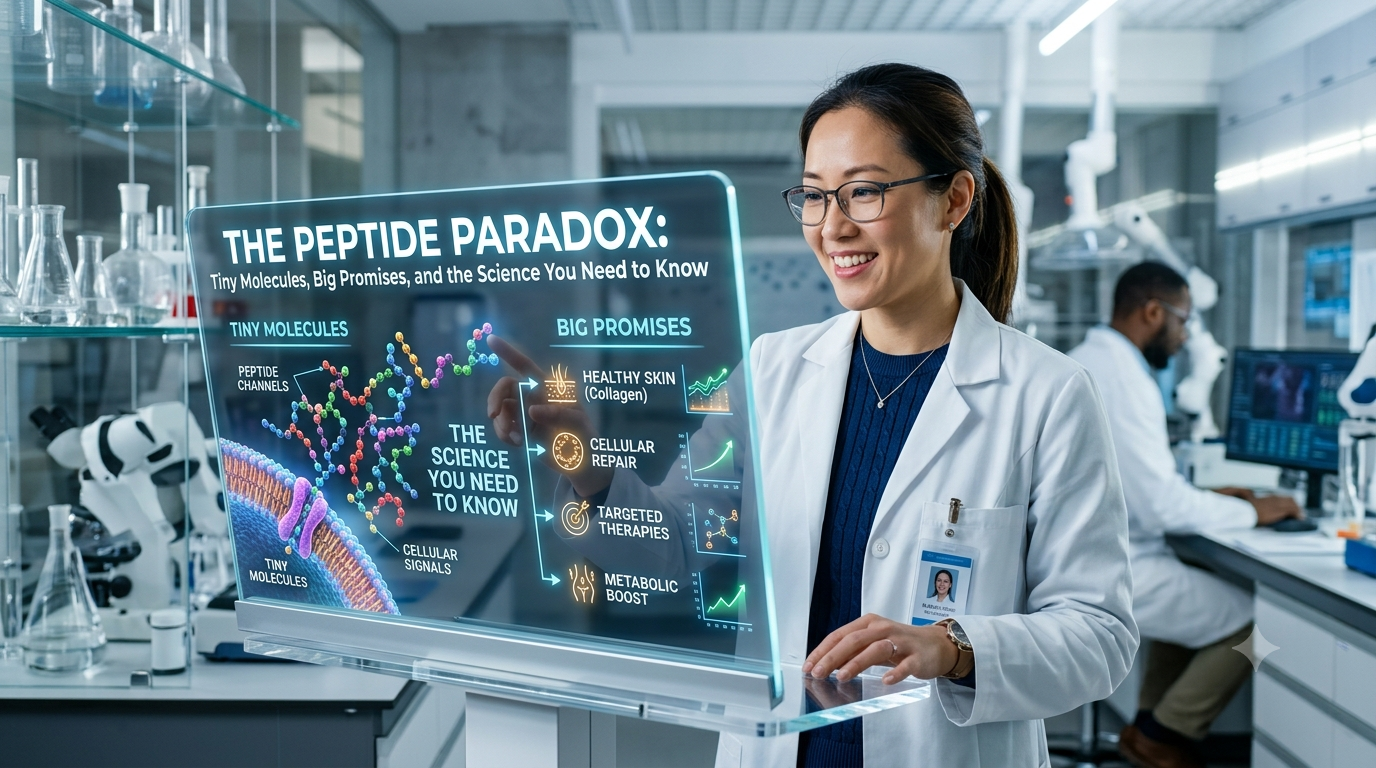
If hormones are the body’s broad announcements, peptides are its text messages—short, targeted, and precise. They tell specific cells to perform specific actions at specific times.
Consider what natural peptides do every moment of your life:
- Insulin instructs muscle, fat, liver, and brain cells to absorb glucose from your bloodstream
- Glucagon-like peptide-1 (GLP-1) signals your brain that you are full and your pancreas to release insulin
- Endorphins dull pain and elevate mood after exercise or injury
- Antimicrobial peptides form part of your innate immune defense against bacteria
- Oxytocin drives social bonding and childbirth
These molecules are not exotic foreign substances. They are the native language of human physiology.
Peptides as Medicine: The Legitimate Side
A Century of Approved Drugs
Peptides are not a modern invention. Insulin was first isolated in 1921 and became one of medicine’s most transformative therapies. Today, more than 80 peptide drugs are approved worldwide, with over 60 cleared by the FDA in the United States alone.
The most recognizable categories include:
| Peptide Drug | Brand Name(s) | Approved Use | Mechanism |
|---|---|---|---|
| Semaglutide | Ozempic, Wegovy, Rybelsus | Type 2 diabetes; chronic weight management | GLP-1 receptor agonist |
| Tirzepatide | Mounjaro, Zepbound | Type 2 diabetes; weight management; sleep apnea | Dual GLP-1/GIP agonist |
| Liraglutide | Victoza, Saxenda | Diabetes; weight management (adults and children 12+) | GLP-1 receptor agonist |
| Tesamorelin | Egrifta | HIV-associated lipodystrophy | Growth hormone-releasing hormone analog |
| Bremelanotide | Vyleesi | Hypoactive sexual desire disorder | Melanocortin receptor agonist |
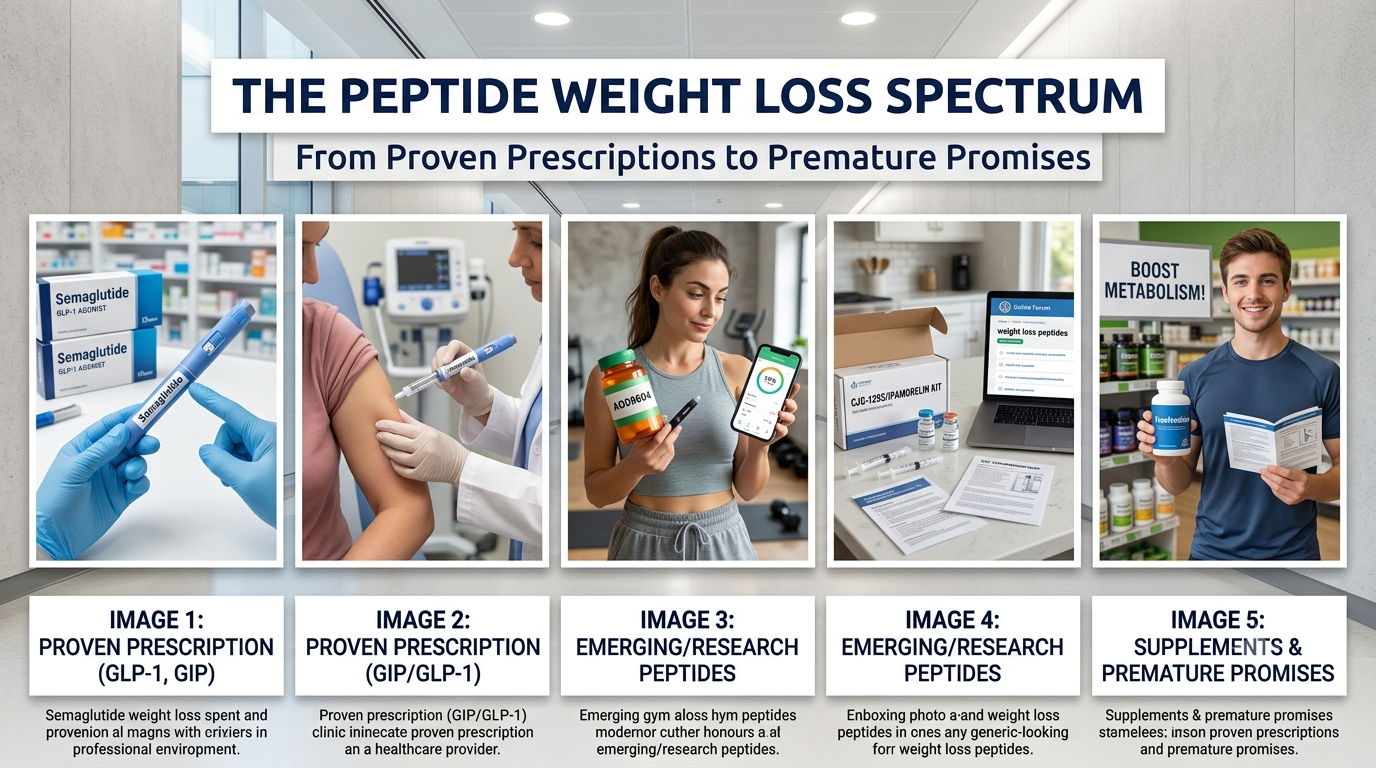
Each of these medications earned approval through years of randomized controlled trials, rigorous manufacturing standards, and demonstrated clinical benefit. They are not sold with vague promises; they are prescribed for specific conditions with measurable outcomes.
Why GLP-1 Drugs Became a Cultural Phenomenon
The rise of semaglutide and tirzepatide brought peptides into everyday conversation. The science is elegant: your gut naturally releases GLP-1 after meals to signal fullness. The problem is that natural GLP-1 vanishes from your bloodstream within minutes.
Pharmaceutical chemists solved this by modifying the peptide’s structure, allowing it to persist for days instead of minutes. The result is a medication that continuously tells the brain “you have eaten enough”—producing weight loss that rivals some surgical interventions.
This is the legitimate face of peptide medicine: engineered molecules with proven mechanisms, tested in thousands of patients, manufactured under pharmaceutical-grade controls.
The Gray Market: Where Promise Meets Risk
A Different Universe
When fitness influencers and biohackers discuss buying peptides online—BPC-157, TB-500, MOTS-c, CJC-1295, ipamorelin—they are describing something entirely different from FDA-approved drugs.
These compounds are sold as “research chemicals” or “research-grade peptides.” The label “for research use only” is not a technicality. It is a legal shield that allows vendors to sell unapproved substances without meeting drug safety requirements.
The defining features of this market:
- No FDA approval for any human use
- No requirement for human clinical trials
- No guarantee of sterility, purity, or accurate labeling
- No regulatory oversight of manufacturing conditions
What the Evidence Actually Shows
For most gray-market peptides, human data ranges from scarce to nonexistent. Claims rest on rodent studies, cell culture experiments, and anecdotal reports—not the rigorous trials required for pharmaceutical approval.
BPC-157, perhaps the most hyped peptide in this category, illustrates the pattern. Animal research suggests possible tissue repair effects. But when analyzed carefully, the measured benefit in some studies was smaller than the placebo response—meaning patients might feel better simply because they believed they would.
More troubling, the same biological activity that might aid healing could also cause harm. BPC-157 promotes angiogenesis, the formation of new blood vessels. This is helpful for wound repair—but it is also a process that cancerous tumors exploit to fuel their growth. A similarly thin body of research has raised concerns about TB-500 accelerating dormant tumor growth in animals.
The Regulatory Reckoning
In 2026, an FDA advisory panel voted to recommend allowing compounding pharmacies to produce four unapproved peptides: BPC-157, KPV, MOTS-c, and TB-500. The vote was nonbinding but signaled a potential shift in policy.
The process drew immediate criticism. Six of the eight newly nominated panel members had financial ties to peptide products, according to federal records. Dr. Eric Topol, a prominent cardiologist, summarized the scientific concern bluntly: “We’re missing safety, we’re missing efficacy—we’re missing the critical evidence.”
Even if compounding pharmacies gain permission, oversight remains unclear. FDA officials acknowledged they have no authority over the state pharmacy boards that would serve as primary regulators.
Peptides in Skincare: A More Nuanced Picture
The Legitimate Mechanisms
Unlike injectable gray-market peptides, topical peptides in skincare have a more credible evidence base. Collagen-building signal peptides have been used in cosmeceuticals for over two decades, with controlled human studies evaluating their effects on photoaging.
The mechanisms are reasonably well understood:
- Signal peptides tell fibroblasts to produce more collagen and elastin
- Carrier peptides (like copper tripeptide GHK-Cu) deliver minerals needed for collagen synthesis
- Neurotransmitter-inhibitor peptides partially block acetylcholine release, softening expression lines
The Realistic Expectations
Dermatologists are cautiously supportive but emphasize that peptides are supporting actors, not stars. “They work, but they’re not the miracle others want you to think,” says Dr. Shasa Hu, a cosmetic dermatologist at the University of Miami Health System.
The key limitations:
- Formulation determines efficacy: Serums penetrate better than creams and can sustain higher peptide concentrations
- They are less powerful than retinoids: Retinol remains the gold standard for anti-aging
- Consistency is essential: Signal peptides are most effective at 2–5% concentration applied for at least 8–12 weeks
If you want to try peptides, choose reputable brands with published research. But do not abandon the basics: sunscreen, moisturizer, and proven ingredients like hyaluronic acid and retinoids.
Safety: The Questions You Must Ask
The Contamination Problem
The most immediate risk with gray-market peptides is what is actually in the vial. Without FDA oversight, there is no guarantee of sterility, potency, purity, or even ingredient identity.
The National Consumers League issued a nationwide warning in 2026 about self-injecting research-grade peptides. Their concerns include:
- Products manufactured in facilities with unknown quality standards, often in China and India
- No assurance of sterility, creating infection risk
- Counterfeit versions of experimental drugs like retatrutide, which could lead to accidental overdoses
Documented Harms
The risks are not hypothetical:
- 2025 Las Vegas anti-aging festival: Two women required ventilators after peptide injections, with symptoms including heart rate elevation, tongue swelling, and loss of neck muscle control
- Australian TGA reports: Adverse events linked to unapproved peptides include liver injury, severe allergic reactions requiring hospitalization, and inflammation needing medical intervention
- Animal studies: TB-500 was observed to accelerate dormant tumor growth
Oral Peptides: Mostly Ineffective
Many peptide supplements are sold as oral capsules or powders. The problem is digestive biology: stomach acid and protein-digesting enzymes break peptides down into individual amino acids before they can be absorbed.
What enters your bloodstream is not the peptide you swallowed—it is its building blocks. This is why FDA-approved peptide drugs are almost exclusively injectables. The pharmaceutical industry has spent millions developing delivery systems to overcome this barrier; supplement companies have not.
Frequently Asked Questions
What is the difference between a peptide and a protein?
Peptides are chains of 2 to 50 amino acids. Proteins are longer chains (more than 50 amino acids) that fold into complex three-dimensional structures. Insulin, with 51 amino acids, sits at the boundary and is often called both.
Can I get peptides from food?
Yes. Any protein source—meat, dairy, eggs, soy, beans—is broken down into peptides and amino acids during digestion. If you eat a balanced diet, you are already getting all the amino acids your body needs.
Do peptide supplements work?
Most oral peptide supplements are ineffective because digestion destroys the peptide before absorption. Injectable FDA-approved peptides work because they bypass the digestive system entirely. Gray-market injectables have unknown safety and efficacy.
Are “research-grade” peptides safe?
No. They are not approved for human use, not tested in human trials, and not manufactured under pharmaceutical quality standards. The National Consumers League and American Medical Association both urge consumers not to self-inject research-grade peptides.
What is BPC-157 and why is it controversial?
BPC-157 is a peptide promoted for injury recovery and gut health. Animal studies show some tissue repair effects, but human data is minimal, and the measured effect in some analyses was smaller than placebo. It may promote blood vessel growth, which could theoretically accelerate tumor development.
Can peptides help with weight loss?
Yes—but only specific FDA-approved peptides. Semaglutide (Wegovy), tirzepatide (Zepbound), and liraglutide (Saxenda) are approved for weight management and produce average weight losses ranging from 8% to 21% of starting body weight. No gray-market peptide has comparable evidence.
Are peptides in skincare worth trying?
Topical peptides have legitimate evidence for improving skin firmness and reducing wrinkle depth, particularly signal peptides and copper peptides. They are gentler than retinoids but less effective. Look for reputable brands and use them alongside—not instead of—proven ingredients.
Helpful Resources
For Evidence-Based Information:
- PubMed (pubmed.ncbi.nlm.nih.gov) — Primary scientific literature on peptide research
- FDA Drug Safety Communications (fda.gov) — Official safety updates and approval information
- National Consumers League (nclnet.org) — Consumer warnings about gray-market peptides
For Clinical Guidance:
- American Medical Association (ama-assn.org) — Position statements on unapproved peptides
- Obesity Medicine Association (obesitymedicine.org) — Evidence-based guidance on peptide-based weight loss medications
For Skincare Science:
- Cleveland Clinic Health Essentials (health.clevelandclinic.org) — Accessible dermatology guidance
- UHealth Collective (news.umiamihealth.org) — Cosmetic dermatology perspectives on peptide skincare
Conclusion: Signal vs. Noise
Peptides are neither miracle molecules nor meaningless hype. They are a diverse class of biological messengers with legitimate medical applications and genuine therapeutic potential.
The critical distinction is between FDA-approved peptide drugs—which have survived rigorous testing and demonstrated real benefits—and gray-market “research peptides”—which have not. Insulin, GLP-1 agonists, and certain topical skincare peptides fall into the first category. BPC-157, TB-500, and the other compounds sold online fall into the second.
If you are considering peptides for a medical condition, talk to a physician about FDA-approved options. If you are considering them for skincare, choose reputable products and maintain realistic expectations. If you are considering injecting gray-market peptides, understand that you are participating in an uncontrolled experiment with unknown contents, unknown risks, and no regulatory safety net.
The biology of peptides is fascinating and the therapeutic future is promising. But promise is not proof—and the gap between the two is where caution lives.
Imp. Note: This article is for informational purposes only and does not constitute medical advice. Always consult with a qualified healthcare professional before starting, stopping, or changing any medication.